Monday, June 6, 2016

Seymour Narrows and Handfield Bay

Leaving Campbell River, there are two choices for a northbound traveler - go north through Discovery Passage and Seymour Narrows, or south around Cape Mudge. We experienced Cape Mudge the day before, and we had enough of that fun. Heck, even the name sounds scary - Mudge - like what you are going to turn into when your boat sinks. So Seymour Narrows it was.

Seymour Narrows is a tidal rapid. Tidal rapids are narrow channels where the tidal flow creates whirlpools, boils, eddys, and overflows. It is similar to a rapid in a river, except that the direction of flow reverses when the tide changes. During the 'slack', the few minutes between the ebb tide and the flood tide, the currents in the tidal rapids may slow down to a degree that the rapids become passable.
Seymour Narrows is quite a famous example of a tidal rapid. There used to be a big, barely submerged, rock (Ripple Rock) right at the narrowest part that created so much turbulence it frequently sank ships. In 1958, the rock was blow
n up in the largest commercial non-nuclear blast in North America.

This is what Wikipedia has to say about Seymour Narrows:
"Seymour Narrows was described by Captain George Vancouver as "one of the vilest stretches of water in the world." Even after Ripple Rock was removed, it remains a challenging route. In March 1981, the Star Philippine, a freighter, ran aground in the narrows.
Seymour Narrows is notable also because the flowing current can be sufficiently turbulent to realize a Reynolds number* of about one billion, which is possibly the largest Reynolds number regularly attained in natural water channels on Earth."
It was still better than Cape Mudge.

We timed our passage to arrive about 45 min before the slack time. The current was so fast we surfed our way there and arrived early, so we milled about for a while and then headed in. We scootched through with only a little bit of white knuckles, mostly mine.

Shooting through Seymour Narrows on a spring ebb tide.


Then it was into Handfield Bay in Thurston Marine Park for some much desired relaxing, crabbing, and general tooling around. Gorgeous, secluded anchorage and a beautiful night.

*I put in that Reynolds number stuff for any of my engineer-buddies who may be reading.


The inclinometer shows the degree of roll.

Friday, June 3, 2016

The last post, again.

Yesterday we motored into Desolation Sound, which, in spite of the foreboding name, is one of the most beautiful areas along the British Columbian coast. We went to Von Donop Inlet, a long narrow islet that leads to a well protected, quiet anchorage. Ahhh, yes! Finally! Time to set the hook, launch the dingy, set some crab traps, go for a hike.

Click. Click click. Click click click. That is the sound the anchor windlass starting making, when we went to release some chain. The correct sound is a loud growling whirr. There were other sounds too, from Frank, but won't be repeated here.

Now a few words about anchors and anchor windlasses for you landlubbers. Boats are not like cars. They don't have a brake. The only way to stop them is to tie them securely to something fixed, like a dock; or to drop an anchor, essentially securing yourself to the bottom. It is more than a convenience. If you have an emergency and need to stop, say you have lost power and you are drifting into rocks, you have to be able to get the anchor down.

The anchor on Gandalf is a 44 lb. Rocna, connected to an all-chain rode (that is boater-speak for a line). It is not like the little Danforth hooks tied to a length of line that you can easily drop and retrieve by hand that you may be familiar with on small runabout boats. The anchor windlass is a machine that deploys and retrieves the anchor and chain. Yes, there are very inconvenient ways to work-around a broken windlass, but the whole scenario is not recommended.

So, we managed to get the anchor down and secured, but then it was time to do some more problem solving. No cell service in the tiny nook we were in, so out came the satellite phone.

We burned some expensive ($1.00/minute) minutes, but we found Ian from Penner Marine in Campbell River.  Another angel!

This morning we headed out at 0600 HRS to cross Sutil Channel, around Cape Mudge in a southeasterly blow, and arrived in Campbell River at 0900 HRS. It is now almost noon, and Ian is packing up his tools, the windlass is fixed. Another f-ing solenoid. How many solenoids are on this boat anyhow?

Ian standing in the hole he had to crawl into to work on the solenoid
Entering Desolation Sound, that's the Rocna anchor under the flag

Wednesday, June 1, 2016

Guy: The Angel of Powell River

I don't even want to tell this story.

We set off from Nanaimo yesterday at 0600 HRS, as planned. Beautiful day, sunny, warm, not a breath of wind. Super easy crossing of the Strait of Georgia.

But... there was a nagging worry. It took 4 pushes of the starter button to start the engine. It should be one push and 'vroom'. This has happened before. The mechanics in Anacortes were supposed to check it out. They said nothing was wrong. But it should not be 4 pushes before the vroom.

So Frank called the mechanics in Anacortes. They said sounds like your solenoid or slave solenoid or maybe the starter. Sorry, we forgot to check it.

By this time we were across the Strait, not going back. Phone calls to many mechanics (too busy, don't do that kind of work) later, we found Guy (pronounced Ghee), in Powell River. Guy wanted photos of the engine room before he would agree to take on the project. Photos taken and sent. Guy says OK. Phew!

The marina in Powell River mostly serves commercial boats, but the wharfinger took pity on us, and gave us a berth.

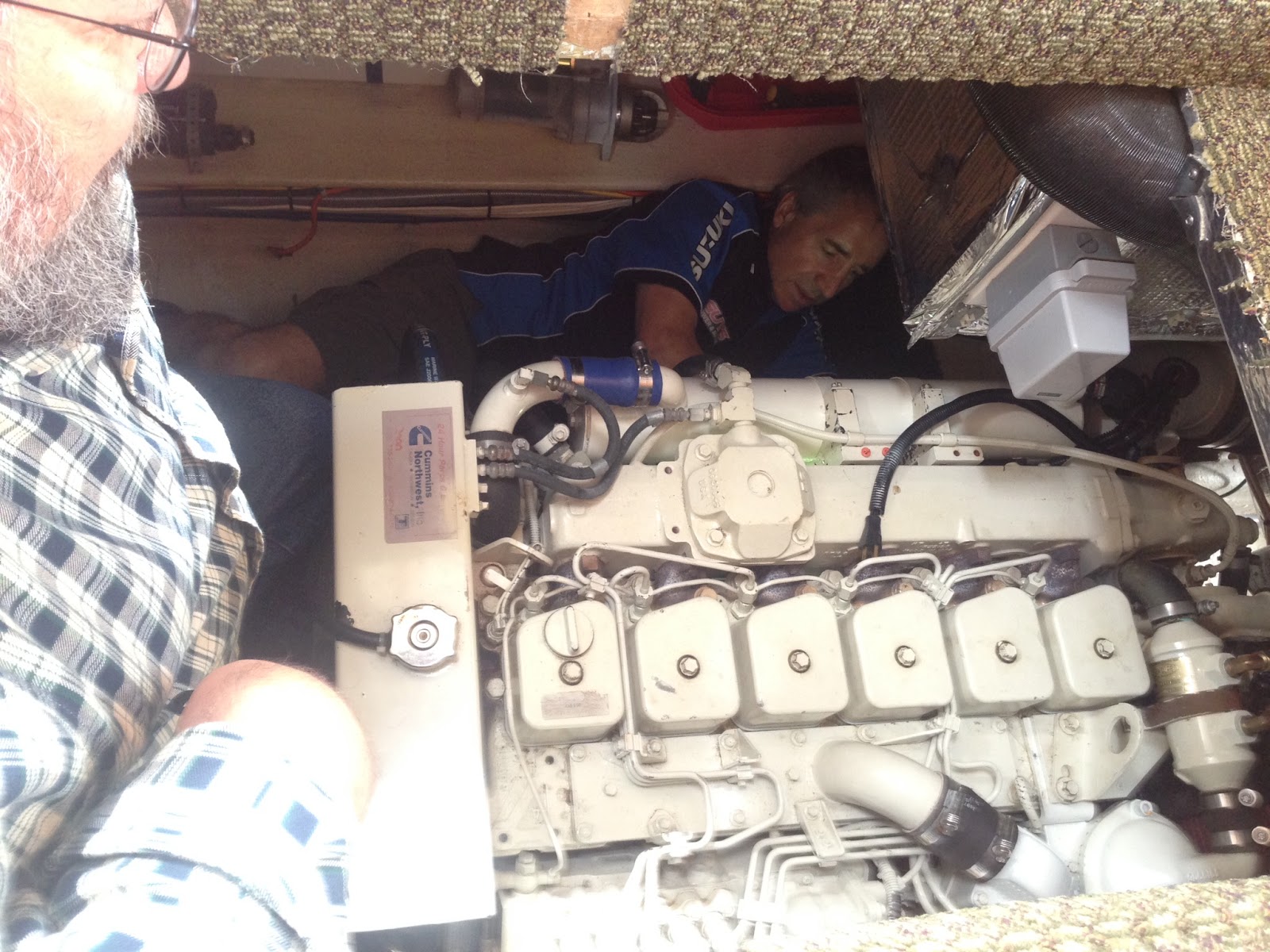
An 'engine room' on a boat can often times be a misnomer. It is more like a crawl space with a giant machine wedged in there. When the boat is built, the mechanical stuff is mounted and then the boat is built around it. Access is best for yoga-practicing skinny children. I am attaching pictures of Guy (in the dark hole there) laying on his side with his arm stuck in some little hole, with Frank supervising.

Ok, so 24 hours later, Guy has removed the starter, taken it to the starter repair people (Vanderkemp Sales and Service who dropped whatever they were working on and promptly repaired the solenoid), picked it back up, brought it to us at the marina, and re-installed it.

One push and vroom.

Guy's Power and Marine, 604-485-5244  http://www.guyspowermarine.com/
Vanderkemp Sales and Service 604-485-9774

Tomorrow we expect to be off for Desolation Sound.


That's Guy down there, in the bottom of the boat

Are you kidding me?

Monday, May 30, 2016

Adventures of Dunvegan... now Gandalf

Ginger here. In our last post, dated July 29, 2007, Frank wrote, "I will return to Alaska in a boat, but under different circumstances."

Today is May 30, 2016, and for the first time since 2007, we are headed to Alaska in a boat.

As Frank said he would, he left Dunvegan in Anacortes, and eventually sold her. We bought back our 20' welded aluminum fishing boat from our son Mike, and that was our only power boat for quite a while. Frank retired, we moved from Montana to Portland, OR. Frank got a Captain's license and spent several summers driving a tour boat (on Flathead Lake Montana) and captaining for saltwater fishing charters in Alaska (at Knudson Cove and South Kaigani Harbor).

In 2013 we got the cruising itch again. It started with the annual trip to the Seattle boat show. There was a 32' Grand Banks for sale, at a price we could afford. I told Frank, let's buy it! He said, whoa, wait a minute. Huh? What?

This led to a year-long quest to find the perfect boat. In January 2014, we closed on M/V GANDALF, a 1999 37' Nordic Tug. We have been outfitting, provisioning, learning, repairing, testing, spending absolutely all our money, and scaring ourselves silly ever since. We knew that a bigger boat was going to be more expensive and of course, more comfortable. I don't think either of us expected that a bigger boat would be so much more complicated and intimidating. 

And then there was a near sinking at the dock (galvanic corrosion is no joke). A son who was diagnosed with Stage 4 lymphoma and needed a year of treatment and support - now thankfully fully healthy. Never ending work demands.

The time has finally come. Yesterday we cast off from our home port of Skyline Marina in Anacortes, headed north. We made it to Nanaimo in one day - a big, tiring day.

As anyone who has attempted any kind of ambitious endeavor knows, there are about a million things that can go wrong. We are feeling a sense of accomplishment at this point, to have gotten this far. Thanks for reading, we will be posting when we can.

Sunday, July 29, 2007

Full Circle


I left Nanaimo early to slip through Dodd Narrows on the tail of the ebb tide. Dodd Narrows is the last, albeit minor, tidal rapids between me and Anacortes. The weather was pretty good but I could have done with a little less breeze.

There were many options and I could have extended the cruise but I was still focused on going home. I called the Small Boat Clearance Center and was once again a bit surprised at the apparent lack of coordination in the Department of Homeland Security. However, I was able to clear Customs without another face to face. I then called the marina in Anacortes and scheduled a haul out for 1000hrs on Friday, the 27th. The next call was to the Motor Carrier Services Division of Montana Department of Transportation to have an over-width permit faxed to the marina. Everything was in place to drag DUNVEGAN back home to Montana.

I motored to an anchorage in Shoal Bay on Lopez Island to make a short hop across Rosario Strait to Anacortes in the morning. I had anchored in Shoal Bay on a previous cruise and found it nice and quiet. This time there were crab trap buoys everywhere and crab boats zipping around the bay like it was some kind of demolition derby competition that lasted until sundown. I stayed anyway and it did quiet down.

I awoke at 0300hrs and climbed into the pilothouse. The water was like glass, the air was warm and still and the sky was light. I stood there at the bridge and looked through all the pilothouse windows, remembering all the days of the cruise. The boat had done everything I asked of her and all without hesitation. She carried me and my first mate on a wonderful passage to Alaska and, with the Lord’s blessing, returned us safely home. It was so peaceful and I felt so at ease. It came to me at that moment; I must sell DUNVEGAN.

I knew I would not be making a similar or better cruise than this one, at least not in this boat, and I would not want to diminish the experience by doing something less. I will return to Alaska in a boat, but under different circumstances. It is now time to pass this great little tug on to someone else so they can experience the joys she still has to offer. I will not be towing DUNVEGAN back to Montana. I will probably leave her in Anacortes and list her with a broker (ouch!).

I hope some of you have enjoyed this blog as much as I have enjoyed putting it together. I am thankful for the encouragement of friends and family along the way and am eternally thankful for having had the opportunity to experience the wonders we’ve seen on this trip and the ability, through technology, to share some of that with you.

I will probably make a couple more posts in the near future when I have an opportunity and will be glad to address any comments. Here are some leftover photos. Thanks!

M/V DUNVEGAN is officially for sale. Inquiries can be sent to fogillin@gmail.com.

Wednesday, July 25, 2007

My Headed Home Face


The weather has turned absolutely beautiful! Unfortunately, as you know Ginger has flown out back to hot, hot, hot Montana.

I have gotten the romantic vision of solo cruising out of my head and so I am now focused on going home.

For those of you who know the area, I motored from Lagoon Cove to Francis Bay (N 50 degrees 21.011' W 125 degrees 02.506') at the lower end of Yaculta Rapids, 69nm, transiting all five tidal rapids. I noticed a Sundowner Tug at the dock in Shoal Bay but I was between rapids and couldn't take the time to stop in. I think it was a 36' with red trim. The further south I get the more boats there are. Going through the rapids was like playing bumper cars! That was the day after Ginger left, yesterday.

Today I left Francis Bay and am now at anchor in Nanaimo Harbour, 88nm! New record for me in a slow boat solo. Excellent traveling weather and favorable currents.

These photos are; my going home face, another shot of Cutter Cove and an example of what I mean when I say there are too many boats. That is a shot of my radar screen while at anchor in Nanaimo (notice the scale).

I should be back in Anacortes in acouple of days. 1963nm to date.

Alaska veteran M/V DUNVEGAN may be for sale.

Changeup


(This was written two days ago and I've traveled a lot since but here is what I had to say then.)

Fog, fog, fog and five straight days of driving rain. These photos are of Lagoon Cove Marina, Ginger's ride and morning in Cutter Cove.

But today is a transition day. Same weather this morning but much improved in the afternoon. Broken skies and the sun is burning hot when it peeks through. The boat is soggy. Soggy to the point that there is mold growing in many, many hard to clean places. Everything that can be opened is now open.

The other part of this transition is that Ginger flew out of Lagoon Cove (N 50 degrees 35.939’ W 126 degrees 18.821’) on a Kenmore Air float plane. The plan was that I would see that she got off OK and then I would head downstream trying to make a full day’s transit in a half of a day. But Kenmore Air was four hours late and put me way behind the curve so I am spending the night in Lagoon Cove again. There are worse things than spending another night here. Tomorrow morning I will shove off at 0530hrs.

I am sad to see her go. Ginger has been the best first mate. I have put her through the fog, the endless rain, the five footers, the eight foot steep-to swells and the long days with not a whimper. There have also been the amazing, beyond belief days sprinkled throughout! She spent 44 days on this little boat with me, that might be asking too much. I would do it again in a heartbeat!

It is really amazing how quickly things can change. I am rapidly shifting back into my singlehanding mode. I have been aboard 65 days as of today and am feeling quite comfortable with it. I was feeling very pressed to push hard to get back to Anacortes once Ginger left but with the weather change and the experiences along the way, I am now starting to want this to never end.